
Japanese Matchmaking
Japanese Matchmaking

Japanese Matchmaking for Foreigners: A Complete Guide to Omiai, Marriage Agencies, and Marriage in Japan
For international professionals seeking a lifelong marriage with a Japanese partner, navigating the modern dating landscape can be an exhausting process of trial and error. Mainstream dating applications often prioritize casual encounters, leading to mismatched expectations, language barriers, and months of unproductive messaging. By contrast, Japanese matchmaking—omiai and structured marriage agency consultation—offers a dignified, intentional, and highly organized alternative. Rooted in centuries of Japanese social tradition and refined by modern relationship counseling, professional matchmaking removes much of the ambiguity of modern dating by connecting individuals whose shared, explicit objective is marriage. Understanding how this system operates—and approaching cross-cultural courtship with emotional intelligence and cultural awareness—provides a clear, structured pathway to building a lasting international partnership.
What Is Japanese Matchmaking? Understanding Omiai in the Modern Era
To Western observers, the term matchmaking often conjures images of historical arranged marriages where family obligations eclipsed personal choice. In modern Japan, however, Japanese matchmaking—known culturally as omiai (お見合い)—has evolved into an entirely voluntary, highly respected avenue for proactive partner selection.
The broader social practice is referred to in Japan as konkatsu (婚活, short for kekkon katsudō, or marriage-hunting activities). Far from carrying a social stigma, participating in konkatsu through a licensed marriage agency (kekkon sōdanjo, 結婚相談所) is widely viewed as a sign of emotional maturity, personal stability, and serious commitment to building a family.
Key Characteristics of Modern Japanese Matchmaking
Clear Alignment of Marital Intent: Registered agency members join specifically to find a life partner, substantially reducing the ambiguous what are we? dynamic common in casual dating.
Verified Backgrounds and Official Documentation: Reputable marriage agencies generally require official proof of single status, photo identification, proof of income, and educational certificates.
Active Professional Mediation: A dedicated consultant guides introductions, communication coaching, and constructive feedback to help prevent cross-cultural misunderstandings.
Autonomous Decision-Making: Modern matchmaking is fully elective. Either party retains complete freedom to decline an introduction or conclude a courtship at any stage with mutual courtesy and zero interpersonal pressure.
Dating Apps vs. Marriage Agencies: Why Serious Singles Choose Structured Matchmaking
Many foreign professionals begin their search for a partner on commercial mobile apps such as Pairs, Bumble, or Tinder. While open-market apps offer high initial volume and low financial barriers to entry, they frequently lead to frustration when the ultimate goal is a stable international marriage. The core distinction lies in structural alignment, verification standards, and ongoing consultative support.
Evaluation Criterion | Casual Dating Apps (Pairs, Tinder, Bumble) | Professional Japanese Marriage Agencies |
|---|---|---|
Primary Relationship Intent | Mixed: casual dating, language exchange, social validation, short-term romance, marriage | Consistently focused on committed, legally recognized marriage |
Identity & Background Verification | Basic SMS, email, or simple photo ID check; details are primarily self-reported | Comprehensive official single-status certificates, passports, verified tax/income slips, and university degrees |
Communication & Disconnection Etiquette | High frequency of abrupt disconnection or ghosting due to lack of social accountability | Governed by agency etiquette; closures are handled formally and respectfully through consultants |
Cross-Cultural Support | Completely unassisted; vulnerable to linguistic and cultural misinterpretations | Bilingual mediation, cultural counseling, and structured communication advisory |
Courtship Structure & Pacing | Indefinite; relationships often continue for years without clear alignment on marriage | Goal-oriented milestones with clear exploratory and serious courtship phases, adapted flexibly to individual needs |
Risk of Misrepresentation & Fraud | Moderate to elevated: undisclosed marital status, romance scams, embellished credentials | Substantially minimized through mandatory legal documentation, identity checks, and personal interviews |
Overcoming Swiping Fatigue and Cultural Misalignment
For international singles, the greatest hidden cost of open-market dating apps is often time. Unregulated platforms frequently feature individuals with divergent relationship goals, varying levels of readiness, or a desire for casual conversational practice rather than marital commitment.
Furthermore, counseling insights show that when cross-cultural friction occurs on apps—such as differing messaging rhythms or misunderstandings stemming from indirect phrasing—users frequently withdraw quietly rather than communicate openly. In a professional Japanese matchmaking agency, an experienced consultant acts as a cultural bridge and emotional anchor. By gathering post-date impressions from both sides, the consultant helps both partners interpret unspoken nuances and understand each other’s genuine perspectives (honne), preventing minor misunderstandings from becoming dealbreakers.
The Step-by-Step Japanese Matchmaking Process: From Profile to Proposal
Entering a professional Japanese matchmaking agency follows a structured, transparent sequence designed to foster mutual clarity while protecting personal boundaries and emotional well-being.
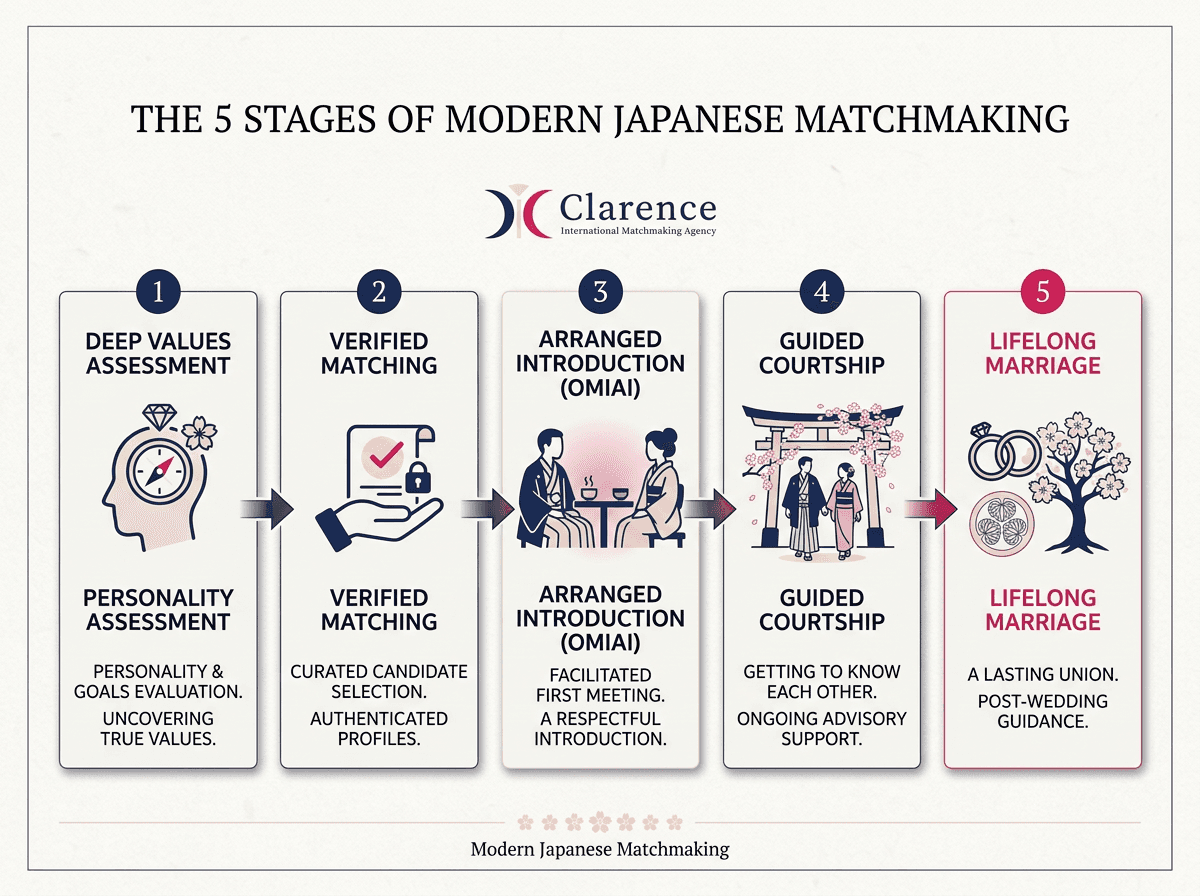
1. In-Depth Consultation and Psychological Profiling
The process begins with an extensive initial consultation with a specialized relationship advisor. Rather than merely recording surface-level physical preferences, a high-touch agency explores deeper relational foundations:
Core Personal and Family Values: Expectations regarding family dynamics, cultural traditions, and long-term marital roles.
Career and Financial Philosophy: Professional trajectories, work-life balance, and attitudes toward household budgeting.
Cross-Border Living Visions: Clear discussions regarding whether the couple intends to reside in Japan long-term or relocate overseas.
Communication Styles and Attachment Patterns: How each individual handles stress, expresses affection, and navigates interpersonal disagreement.
2. Document Verification and Official Registration
To maintain trust and safety across the agency’s network, members submit certified legal documentation:
Government-issued photo identification (passport or national ID).
Official proof of single status (dokushin shōmeisho, 独身証明書) or a certified legal equivalent from a home country.
Verified proof of income (such as tax withholding slips or certified pay statements) and proof of graduation for university degrees.
High-quality professional portraits that present members naturally and respectfully.
3. Handpicked Matching and First Introduction (Omiai)
Once prospective partners express mutual interest in reviewing one another’s profiles, the agency arranges a formal first meeting (omiai, お見合い).
Format: For members living overseas, the first introduction typically takes place via a structured 45- to 60-minute video conference arranged and supported by the agency. For members residing in Japan, meetings are traditionally held at a refined hotel lounge or quiet café.
Focus: The goal of the omiai is not an immediate romantic commitment, but rather assessing fundamental chemistry, mutual conversational comfort, respect, and emotional ease.
4. The Two-Stage Courtship: Kari-kōsai and Shinken-kōsai
In standard Japanese matchmaking frameworks—such as those established across major domestic agency networks like the IBJ (Japan Marriage Consulting Federation)—the courtship process is commonly structured into two distinct developmental phases:
Exploratory Courtship (Kari-kōsai, 仮交際): A non-exclusive exploratory phase where both individuals go on casual dates, converse regularly via messaging or video calls, and assess mutual compatibility. Because this stage is designed for discovery, members may continue meeting other candidates to ensure thoughtful decision-making without premature pressure.
Exclusive Serious Courtship (Shinken-kōsai, 真剣交際): Once both individuals establish strong mutual feelings and aligned values, they mutually agree to enter an exclusive courtship. At this milestone, other introductions and profile views are paused. The couple focuses on essential marital topics: household values, lifestyle habits, career integration, family planning, and geographic arrangements.
While domestic industry frameworks often suggest general pacing benchmarks, experienced international agencies understand that cross-border relationships—especially those involving international travel, work commitments, and visa considerations—require realistic flexibility, personalized pacing, and careful advisor support.
5. Marriage Proposal, Family Introductions, and Formal Engagement
When both partners confirm their shared commitment to marriage, a formal proposal takes place. The agency provides advisory support for the cultural etiquette of meeting the partner’s parents (goryōshin e no aisatsu, ご両親への挨拶), pre-marital legal documentation, and cross-border administrative preparation.
Cross-Cultural Psychology: Navigating Courtship Beyond the Stereotypes
A successful international marriage requires shedding superficial cultural tropes and developing genuine psychological empathy. Western media frequently portrays Japanese women through outdated, monolithic stereotypes. In reality, Japanese individuals seeking an international marriage represent diverse backgrounds: they are often worldly, professionally accomplished, emotionally self-aware, and seeking an egalitarian partner who respects their individuality and values their voice.
While individual personalities and communication styles vary widely, cross-cultural relationship counseling highlights several common communication dynamics and psychological concepts that frequently shape Japanese social interactions:
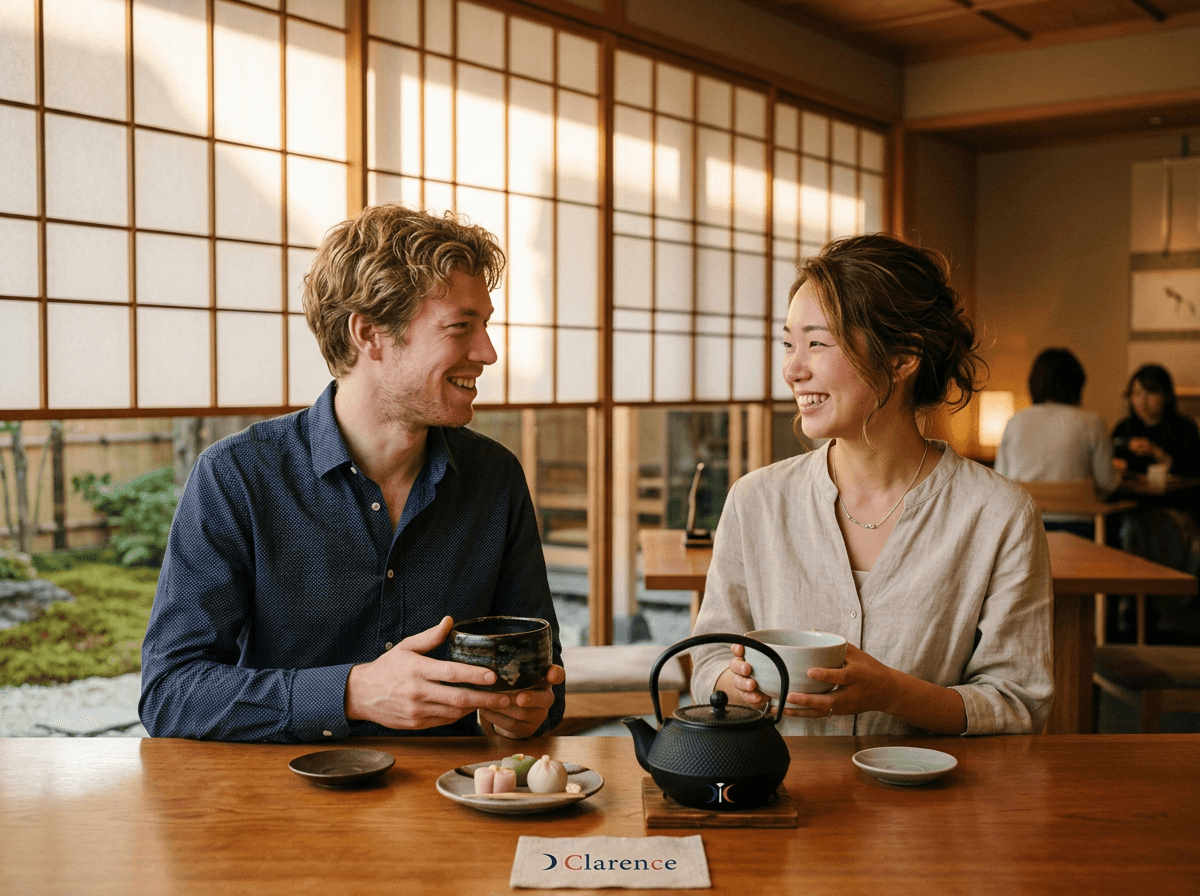
1. High-Context vs. Low-Context Communication Dynamics
Cross-cultural psychologists frequently categorize Western societies (especially the United States, Canada, the UK, and Northern Europe) as generally “low-context” communication cultures—where meaning is often stated explicitly and directly in words. Japanese social interaction, by contrast, often leans toward a “high-context” communication style, where situational context, non-verbal cues, and emotional nuance play a significant role.
In dating and courtship, counseling insights suggest keeping these tendencies in mind:
Tone and Pacing: Direct assertiveness or confrontational debate, even when well-intentioned, can sometimes feel overwhelming. Thoughtful phrasing, considerate pauses, and maintaining a calm conversational demeanor foster an inviting space for open dialogue.
Attentiveness to Context (Kūki o Yomu, 空気を読む): Rather than expecting immediate verbal disagreement, pay gentle attention to subtle hesitations, softening qualifiers, or indirect phrasing (such as “that might be slightly challenging,” which often signals polite reluctance).
2. Creating Psychological Safety for Honne (True Feelings)
Japanese social psychology often describes two complementary relational concepts:
Tatemae (建前): The polite, harmonious public-facing demeanor commonly adopted to maintain social balance, respect interpersonal boundaries, and avoid causing discomfort.
Honne (本音): A person’s genuine inner feelings, vulnerabilities, personal desires, and authentic opinions.
During the early stages of courtship, a Japanese partner may naturally lead with tatemae out of courtesy, modesty, or caution. If a partner pushes too aggressively for rapid declarations or reacts defensively to minor differences, the other party may retreat into polite formality.
Counseling experience indicates that transitioning naturally from tatemae to honne requires creating consistent psychological safety:
Respond to opinions with genuine curiosity and positive validation rather than quick debate.
Model healthy vulnerability by sharing personal reflections in a calm, grounded manner, which naturally invites reciprocal openness.
Practice active, empathetic listening (keichō, 傾聴), allowing ample time and patience for your partner to articulate complex thoughts, especially when communicating across a second language.
3. Cultivating Anshin-kan (安心感 — Emotional Security and Peace of Mind)
In Japanese relationship psychology and marriage counseling, one of the most vital qualities sought in a life partner is anshin-kan (安心感)—a profound sense of emotional safety, mutual trust, dependability, and calm predictability.
Anshin-kan is rarely created through grand verbal declarations or dramatic romantic gestures. It is built steadily through reliable actions: punctuality, transparent and steady communication, emotional self-regulation during stress, and consistent respect for your partner’s boundaries and feelings. When anshin-kan is established, cross-cultural differences become manageable opportunities for mutual growth.
Key Factors for Success: What Japanese Partners Value in an International Relationship
According to demographic records from the Japan Ministry of Health, Labour and Welfare (MHLW), approximately 20,000 to 21,000 international marriages are registered annually in Japan. While cross-border unions are well-established, long-term marital success depends on fundamental interpersonal compatibility, mutual emotional maturity, and practical life alignment.
Although individual preferences and relationship priorities always vary, relationship counselors frequently observe several key qualities that Japanese partners value when considering an international marriage:
1. Sincerity, Humility, and Emotional Maturity
In Japanese courtship norms, excessive bravado or performative romantic gestures often create skepticism rather than attraction. Partners tend to highly value emotional consistency, sincerity, and quiet humility (kenson, 謙遜). Following through on commitments, maintaining composure during disagreements, and treating service staff, friends, and family with steady respect communicate genuine integrity far more powerfully than verbal promises.
2. A Collaborative Vision for Future Living and Career
One of the central considerations for anyone entering an international union is geographic and lifestyle stability:
Residency Planning: Where will the couple build their life? Whether the plan involves establishing a home in Japan (such as Tokyo, Yokohama, or Osaka), relocating overseas, or maintaining a flexible cross-border lifestyle, having a realistic, well-researched, and adaptable vision provides immense confidence.
Respect for Career and Autonomy: Many individuals seeking marriage through professional agencies are dedicated career professionals. Demonstrating active support for your partner’s professional ambitions, personal passions, and individual autonomy fosters a modern, egalitarian partnership.
Family Integration: Respecting your partner’s relationship with their parents and family in Japan—including holiday traditions, visits, and long-term parental care—shows that you approach marriage as a holistic union between two families.
3. Sincere Cultural Curiosity (Without Pressure for Immediate Fluency)
While fluency in Japanese is rarely an immediate prerequisite—particularly in an international agency setting where many members possess conversational or fluent English skills—demonstrating genuine curiosity about Japanese culture is invaluable. Making an effort to learn foundational conversational phrases, appreciating everyday customs, and showing openness to local cuisine and traditions signals that you are committed to building a shared cultural bridge together.
4. Transparent Financial and Lifestyle Values
In Japanese relationship culture, practical conversations regarding household budgets, saving habits, career stability, and long-term financial security are standard, healthy components of pre-marital courtship. Approaching financial discussions with openness, transparency, and collaborative planning reinforces your dependability as a prospective life partner.
How to Choose the Right Japanese Matchmaking Agency for International Marriage
Selecting the right agency is one of the most consequential decisions in your konkatsu journey. While thousands of domestic marriage consultation bureaus operate across Japan, standard domestic agencies are typically built for Japanese-speaking couples living locally and may lack the linguistic, administrative, or psychological tools required for cross-border relationships.
When evaluating an agency for international marriage, consider these essential criteria:
1. True Bilingual and Bicultural Expertise
Many traditional domestic agencies operate exclusively in Japanese and lack experience with Western communication norms. Look for an agency staffed by consultants who possess extensive international experience and understand both direct Western communication styles and high-context Japanese nuances. This bicultural insight prevents innocent linguistic missteps or differing social cues from derailing a promising connection.
2. Psychology-Informed Coaching and Relational Guidance
Mass-market database services often function merely as profile directories, leaving communication and date progression entirely up to chance. In contrast, high-touch boutique agencies provide personalized, psychology-grounded advisory before and after each introduction. Dedicated consultants help you interpret subtle feedback, navigate cultural etiquette, and build genuine emotional resonance.
3. Strict Document Screening and Safety Standards
A reputable agency should uphold strict verification protocols. Requiring certified single-status documentation (dokushin shōmeisho), government identification, verified tax/income slips, and university credentials ensures that every member in the network is legally single, professionally verified, and genuinely committed to marriage.
4. Structured Cross-Border Logistics and Flexibility
Whether you currently live in Japan, work remotely, or plan to travel to Japan for arranged meetings, ensure the agency accommodates international schedules. A specialized cross-border agency will provide structured online omiai coordination, optimized in-person meeting itineraries, and logistical guidance regarding international visas and relocation.
5. Transparent Pricing and Aligned Fee Structures
Established agencies typically operate with clear, transparent pricing models comprising an initial registration fee, monthly membership dues, and a success fee (seikōryō, 成婚料) payable upon formal engagement. This structure aligns the agency’s incentives directly with your successful, lasting marriage rather than indefinite membership retention. Be cautious of services with ambiguous contracts or hidden ongoing charges.
Comprehensive Support for International Members at Clarence
For foreign professionals seeking a life partner in Japan, navigating matchmaking requires more than just introductions—it demands a cohesive ecosystem of linguistic, cultural, and logistical support. As a specialized international marriage agency based in Japan, Clarence International Marriage Agency provides an end-to-end support framework designed specifically to address the unique challenges of cross-cultural courtship.
Why Clarence Is Uniquely Equipped for International Members
Bilingual & Bicultural Leadership: Founded with international expertise and deep roots in Japan, Clarence bridges Western communication directness with Japanese relational nuance.
Psychology-Grounded Guidance: Advisory is rooted in evidence-based relationship psychology, attachment styles, and cross-cultural counseling rather than superficial matching algorithms.
Holistic Cross-Border Readiness: We address the complete journey—from verified introductions and language acquisition to spousal visa guidance and relocation logistics—ensuring couples build a sustainable life together in Japan or abroad.
At the core of our service is the Clarence Standard Plan, an all-inclusive framework that seamlessly integrates personalized matchmaking, structured language acquisition, relocation readiness, relationship education, and ongoing cross-cultural counseling:
1. Dedicated English-Language Matchmaking and Consultation
Foreign members receive complete support in English from experienced, bilingual consultants. From profile creation and psychological intake to date arrangements and post-meeting debriefs, our team ensures that you never feel lost in translation, bridging cultural and linguistic nuances at every step.
2. JLPT N5–N2 E-Learning Curriculum
While high Japanese proficiency is not required to begin matchmaking, language growth significantly strengthens long-term relationship bonding and daily life in Japan. As an integral component of the Standard Plan, Clarence provides foreign members with access to structured JLPT (Japanese-Language Proficiency Test) N5 through N2 e-learning courses. This curriculum focuses on practical conversational Japanese, daily relational vocabulary, and cultural context, allowing members to steadily advance their language ability at their own pace.
3. The Japan Remotely Relocation Curriculum
For members planning to establish their lives in Japan, the proprietary Japan Remotely curriculum—integrated directly into the Standard Plan—offers practical, comprehensive guidance on moving and settling smoothly. Topics covered include:
Navigating Japanese visa pathways and legal residency requirements.
Securing housing, understanding lease agreements, and selecting family-friendly neighborhoods in Tokyo and beyond.
Setting up banking, health insurance, tax registration, and essential daily infrastructure.
Adapting to remote work and local employment customs in Japan.
4. The Marriage Skills Curriculum
Building a strong, enduring cross-cultural union requires proactive relational tools. Integrated into the Standard Plan, the Marriage Skills curriculum provides practical training grounded in relationship psychology and cross-cultural communication, addressing:
Constructive conflict resolution and communication frameworks across low-context and high-context cultures.
Aligning family financial philosophies, household management, and career integration.
Developing emotional intimacy, mutual vulnerability, and sustainable marital habits.
5. Cross-Cultural Psychological Counseling and Date Mediation
Before and after every omiai and date, consultants provide personalized psychological debriefs. These sessions help foreign members accurately interpret unspoken signals, understand their partner’s cultural perspective, manage courtship pacing, and cultivate lasting anshin-kan (emotional security) throughout both kari-kōsai and shinken-kōsai phases.
6. Relevant Post-Marriage and Family Integration Support
Clarence’s guidance does not conclude with a marriage proposal. We offer continuous consultative assistance through the transition to married life, including guidance on formal family introductions (goryōshin e no aisatsu), international marriage registration procedures, spousal visa applications, and adapting to bicultural family life.
Conclusion: Taking the First Step Toward Your Cross-Cultural Future
Finding a lifelong marriage partner in Japan is an enriching and deeply rewarding journey, but it requires moving beyond the noise of casual dating apps and the pitfalls of cultural stereotypes. Modern Japanese matchmaking offers the clarity, security, and structured intentionality necessary for two individuals from different cultural backgrounds to connect on what truly matters: shared life values, mutual emotional safety, and a committed vision for the future.
By approaching the omiai process with genuine humility, active listening, and the guidance of dedicated bicultural matchmakers, you replace uncertainty with intentional progress.
If you are a serious foreign professional ready to build a lasting, fulfilling marriage with a Japanese partner, take the first proactive step. Reach out to Clarence International Marriage Agency to schedule a confidential consultation and discover how personalized, psychology-informed matchmaking, language learning, and cross-cultural relocation support can guide your path to marriage in Japan.
Ready to take the first step?
Schedule a confidential conversation with Clarence to discuss your international matchmaking journey.
Schedule a Free Consultation